A Passage Through Contemporary Art
In every era, art has offered the world something deeper than mere decoration. It has been protesting. It has been prayer. It has been memory etched into pigment, revolution hidden in shadow, desire traced in line. When language fails and facts crumble, art continues—witnessing, dreaming, enduring.
We believe that to show art is not to sell spectacle—it is to share resistance. And in today's shifting world, where everything feels simultaneously too fast and painfully fragile, we strive to be a sanctuary. A space where the past breathes through the brushstroke, and the future dares to speak through the canvas.
Why Us?
We draw our name from the Roman deity Janus – the god of doorways, duality, and thresholds—who looks both forward and back. That is the very ethos of our curatorial lens.
Within our walls—both physical and digital—you'll find stories stitched into fabric, grief layered into oil, migration carved into wood, and silence breaking open through ink. These are not merely contemporary paintings. These are portraits of the world that remain unseen, unheard, and often unloved.
The Digital Shift: An Intimate Revolution
We took our roots and carried them online—not to escape the physical, but to extend its heartbeat. The digital doesn't flatten—it unfolds. In our online gallery, you can pause in front of a work and let it gaze back at you. You don't need to rush.
Our artists—emerging and established—trust this space to hold their vulnerability and their rage, their archives and their dreams. To view their work is to enter their world—and in doing so, to find pieces of your own.
Art as Archive, Activism and Afterlife
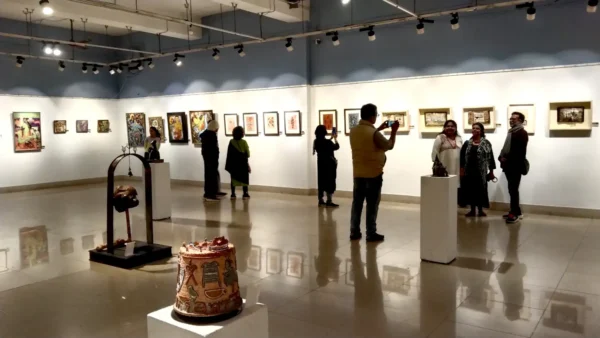
Art is not what we look at—it is what looks back. At Janus, we have had the honour of exhibiting works that do not simply capture a moment; they carry entire histories. From installations exploring river ecologies and gender fluidity to canvases confronting industrial violence or resurrecting forgotten crafts, each exhibition becomes an act of witnessing.
The artists we work with do not paint to impress; they paint because they cannot forget. And neither should we.